
Shared Spatial Awareness
Dynamic industrial environments increasingly combine autonomous robots, workers and infrastructure for more efficiency and speed. Yet when robots cannot fully perceive what is happening around them, delays, unnecessary stops, and inefficiencies can occur. While other systems try to improve the way a robot responds to the unexpected, TNO aims to reduce the uncertainty itself.
Aligning the view
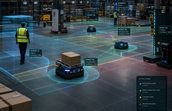
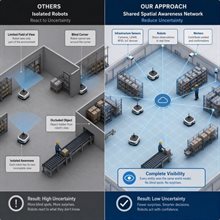
Current autonomous robots and digital systems largely rely on their own sensors and local maps. This can lead to blind spots, occlusions, and inconsistent world models. As a result, autonomous systems act conservatively, which limits efficiency, coordination, throughput, and scalability in mixed human-machine environments. Warehouses, factories, and logistics hubs struggle to safely deploy larger autonomous fleets due to unpredictable or limited behaviour of autonomous systems.
While the majority of existing solutions focus on improving a robot’s reaction to uncertainty, TNO is developing a solution that reduces the uncertainty itself. With distributed, synchronised sensing across multiple devices and locations, humans, robots, and infrastructure share a single, real-time understanding of their environment. By combining data from multiple sensing nodes, synchronising them, and fusing them into a unified spatial model or Digital Twin, TNO’s solution creates a shared understanding of reality. This represents a novel approach to collaborative spatial awareness.
Combining expertise for novel solutions
TNO's Shared Spatial Awareness approach does not replace existing sensing and automation systems; it builds on them. Cameras, LiDAR, Digital Twins, AI, and communication networks are already widely deployed in industrial environments, but they often operate as separate systems with limited awareness of one another. TNO brings these technologies together into a shared, real-time view of the environment and will validate whether this technology convergence can reduce uncertainty, improve coordination, and unlock greater value from existing robotics and automation investments. Rather than reinventing the individual building blocks, the innovation focuses on making them work together more effectively.
TNO builds on more than a decade of expertise in immersive technologies, XR communication, photorealistic 3D capture, distributed software architecture, AI-driven data processing, and 5G/6G systems. This knowledge leads to a single, broad spatial-awareness approach to address the core issue of robot uncertainty instead of simply improving how a robot responds. In this way, future autonomous systems will be safer, more efficient, less conservative in their behaviour, and more scalable.
The system is aligned with future capabilities, such as ultra-low-latency communication, distributed intelligence, and integrated sensing. The solution can derive application-driven networking requirements for future 6G. All components are designed to be modular, technology-agnostic, and compatible with future sensing and networking developments to reduce the risk of vendor lock-in.
Sharing awareness for increased efficiency
Shared Spatial Awareness is a prime example of TNO’s multidisciplinary approach. By combining a variety of expertise to address this industrial challenge, TNO is developing a solution that reaches beyond better individual sensor capability toward a more synchronised, shared environmental view.
When human and digital systems share the same, realistic view of a work environment, coordination and safety can improve. Operational efficiency is expected to grow, even in complex environments. Robots will no longer need to default to conservative safety choices, because their real-time perception will enable the right action at the right time. Blind spots and occlusions can be reduced, which can enable higher throughput and increased scalability. Reducing unnecessary stops and conservative behaviour can improve throughput, asset utilization, and operational efficiency. Beyond factories, warehouses, and logistics hubs, a fully mature solution could also benefit airports, ports, and future mobility systems.

Simon Gunkel - Project Lead of Shared Spatial Awareness
Join the next generation of autonomy
Warehouse operators, logistics providers, and factory owners using Autonomous Mobile Robot (AMR) systems already know the challenges and limitations of the current state-of-the-art. With TNO, they have the opportunity to test and validate novel concepts that reduce those limitations and enable a scalable solution that increases safety, efficiency, and cost-effectiveness.
TNO has already validated essential building blocks – such as sensing pipelines, calibration mechanisms, distributed processing, and networked XR systems. Now, it aims to integrate all of these components into a unified spatial sensing approach and validate it in an industrial setting. Warehouse operators and logistics providers experiencing AMR challenges are encouraged to get in touch. In addition, AMR manufacturers and system integrators and industrial automation and safety solution providers can benefit from partnering with TNO on developments. TNO also seeks collaboration with 6G ecosystem partners, strategic investors, and technology transfer partners interested in the convergence of 6G, AI, and 3D sensing to improve the operational capabilities of Autonomous Mobile Robots and other industrial automation systems.
Could Shared Spatial Awareness technology benefit your market position? Contact us for investment or collaboration opportunities.
Contact us
-

Leonne Dieleman
Functie:Tech Transfer OfficerSpecialisatie niet bekendLeonne joined the team in 2025, with a strong foundation in startup development. She is committed to help tech startups with their market validation, value proposition and team structuring through engagement and iterative learning. Empowering early-stage ventures to achieve product-market fit and sustainable growth through the right tools and strategic support.
-
E-mail:E-mail Leonne
-
LinkedIn:Leonne on LinkedIn
-