
PolySCOUT
Accelerating the materials transition requires better-performing, safer and more sustainable polymeric materials. Not only to reduce the impact of plastic production, but also to improve their end-of-life options.
PolySCOUT, a TNO Venture, accelerates the transition to advanced, biobased polymeric materials. It combines polymer science with a powerful machine‑learning solution that speeds up and improves material design.

The need for change
Plastics are an integral part of modern life and will continue to play an important role in a sustainable future. However, they are currently produced primarily with fossil feedstocks. This production and eventual disposal pose serious threats to our environment and health. There is a strong need to reduce greenhouse gas emissions during production, as well as plastics’ end-of-life impact, including pollution from litter. For example, microplastics seep into the soil and water, and consequently into our food and bodies.
Demand for plastics made from renewable carbon feedstocks—recycled materials, biomass, and captured CO₂—is accelerating. In addition to being made from these feedstocks, novel polymers also require a combination of (technical) performance, sustainability, affordability and scalability. These new materials perform better and are safe and sustainable by design. They also offer appropriate end-of-life options, such as recyclability or biodegradability. Yet new material introduction is constrained by the slow, costly and trial‑and‑error nature of polymer development.
Forward fast
Bringing a new polymer from concept to market typically takes 20-30 years of research, documentation and scaling. Polymer design is vast and complex: accurately modelling materials and predicting their behaviour remains a major challenge. And design is only the beginning. Polymers must still be synthesised, compounded, scaled, processed and tested in real products before they can be considered commercially viable.
The fossil‑based polymers we rely on today have benefitted from nearly a century of optimisation to reach their current performance and cost levels. But polymer producers and end‑users do not have another 100 years—or unlimited budgets—to develop sustainable alternatives. To meet the 2050 transition targets, the industry urgently needs faster, smarter and economically viable ways to identify and develop polymers with the right properties. Accelerating polymer development is no longer optional; it is essential.
Accelerating the transition
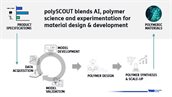
PolySCOUT accelerates the transition to sustainable polymeric materials by uniquely combining polymer science with AI‑driven, application‑first design. Our advanced models simultaneously predict polymer behaviour across technical performance, safety, sustainability and cost effectiveness, enabling informed material choices early in development. It designs directly from product specifications, thereby significantly shortening development cycles and enabling faster scale‑up and market readiness.
Crucially, the polySCOUT solution is not limited to digital predictions: designed materials are synthesised, characterised and validated in our laboratories and, where required, further scaled into plastics through our industrial partner network. This integrated digital‑to‑physical approach allows polySCOUT to deliver real‑world materials that actively accelerate the shift toward sustainable plastics in the most demanding applications.
Recipe for success
PolySCOUT offers a uniquely integrated, end‑to‑end workflow that combines AI‑driven polymer design, viability assessment and physical material validation. Our portfolio of advanced machine‑learning models captures polymer complexity through state‑of‑the‑art fingerprinting approaches, enabling a step‑change in the discovery and optimisation of complex (co‑)polymer systems. These models continuously learn from a rigorously curated, ever‑growing data foundation that brings together TNO’s proprietary research, technical data sheets of commercially available materials, and high‑quality data from scientific literature curated by our polymer experts.
What truly sets polySCOUT apart is the tight coupling of this digital intelligence with experimental synthesis, characterisation and scale‑up, allowing better materials to be designed, validated and de‑risked from the very start of development.
Partnering for acceleration
PolySCOUT can be particularly beneficial for end-users and producers of high-performance materials. Particularly in sectors where innovation and specific product properties play an important role during and after use, including electronics, automotive and textiles. We work with partners via joint development agreements or contract research. Contact us to combine AI, materials science and industrial validation to enable faster, smarter development of polymer materials that are ready for market impact.
Could PolySCOUT technology benefit your market position? Contact us for investment and/or development opportunities.
Contact
-

Camilla van Wirdum
Functie:Tech Transfer OfficerSpecialisatie niet bekendCamilla joined the team in 2022, building on her experience in TNO research departments since 2020. Passionate about creating tangible impact with research, she advocates for entrepreneurship and seeks to translate high-potential innovations into market success.
-
E-mail:E-mail Camilla
-
LinkedIn:Camilla on LinkedIn
-